|
 |
|
Color
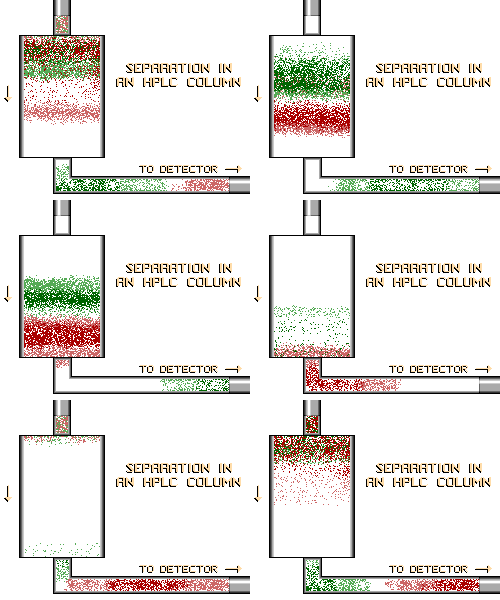
Cycling. Back when computer memories were measured in Ks rather than Ms or Gs, an
economical way to produce animation was to cycle the color palette. The pixel data, an
array of indexes into a color lookup table, doesn't change at all. The colors in the table
are cycled to create the illusion of motion. (I'm pretty sure you can't do this in GIF. In
fact, there's a full-color GIF trick that relies on palettes being frame-local.) |
|
 |
|
|
|
|
Program
Driven. While playing around with random dissolves and animated effects, I wrote
an AmigaBASIC program to create this frog. He appeared on the screen one random block at a
time, then his eye and mouth sequences were played at random intervals. I used the Amiga's
built-in text-to-speech facility to give him a good croak. The random feel is recreated
here by making the frame rates of the parts relatively prime, but in the original, he
could go for a long time without croaking, which gave the animation an element of
suspense. |
|
 |
|
Yeah,
I know, but my wife thought he was cute. This, of course, is Unilever's fabric
softener bear. |
|
 |
|
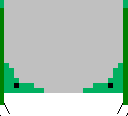
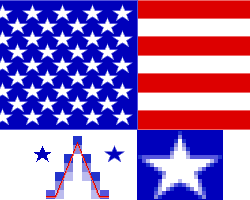
Antialiasing.
Note the difference between the two small blue stars in the lower left. One exhibits
aliasing, a jagged stairstep effect caused by undersampling. The edges of the other one
have been blurred in a precise way that, while not eliminating the sampling error, spreads
it around so that it's much less objectionable to the eye. I antialiased a number of my
early images by hand, one pixel at a time. The antialiased drawing tools everyone now
takes for granted didn't exist. |
|
 |
|
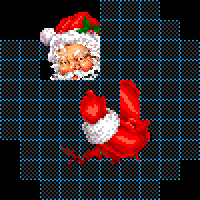
Cross
Stitch. For a time, I experimented with using needlepoint and cross stitch
patterns to paint images, sort of a digital paint-by-numbers. The patterns seemed ideal
for this, since they were already laid out on a grid and used a relatively small palette.
The results were often excellent, but they're unoriginal, of course, and the work is
incredibly tedious, with none of the salutary meditative benefits of doing real
needlepoint. I considered doing this in reverse, turning original digital images into
needlepoint patterns, but I never actually tried it. |
|
 |
|
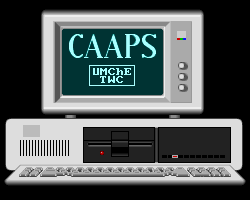
IBM
PC XT. Remember when every computer looked like this? Compared to current
machines, the CPUs were a thousand times slower and the hard drives ten thousand times
smaller. Their 12-inch screens supported 16 colors, and their speakers supported sounds
like "beep," "beeeeep," and other beepish and clicky noises. An XT
cost $5000 in 1985. I painted this for my father-in-law. CAAPS was a process simulation
program he wrote for his chemical engineering students. |