


| |
|
|
|
DNA Molecule
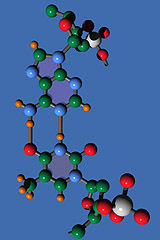
 This is a classic Watson-Crick model of DNA (deoxyribonucleic acid) built and rendered in LightWave 3D. The model was generated by a plug-in that accepts arbitrary base sequences and provides settings for different atom and bond shapes and colors. I've included the source code in the LightWave SDK. |
|
 |
In 1953, Francis Crick
and James D. Watson published a now-famous paper in the British science journal Nature that announced their discovery of the
structure of DNA. The geometry of the models shown here is based on reprints of that and
other papers in the W.W. Norton edition of Watson's
popular account, The
Double Helix (edited by Gunther Stent), with minor corrections from more recent
textbooks (J. Bailey and D. Ollis, Biochemical Engineering
Fundamentals, 2nd ed., McGraw-Hill,
1986). The model of the DNA chain is built up from nucleotide base pair modules, each of which contains a pair of complementary bases attached to fragments of sugar-phosphate backbone. At left is the adenine-thymine module. The modules are designed to fit together when spaced at intervals of 0.34 nm and 36 degrees along the fiber axis (left-right for the chain image, in-out for the module image). The DNA fragment above contains 30 base pair modules, a total of 1485 atoms represented by 92,070 points and 106,920 polygons. |